
First Album
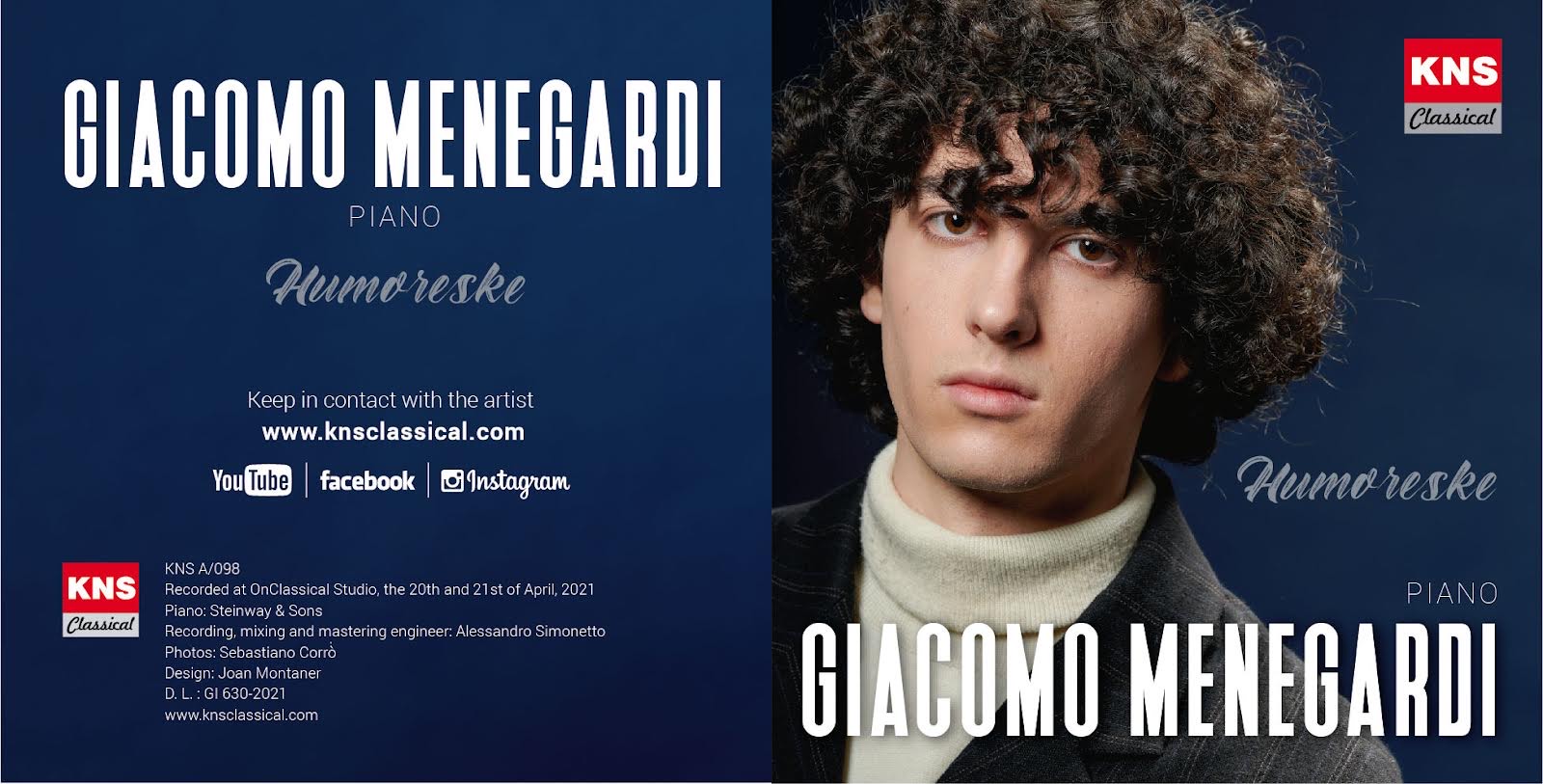
Humoreske
I have listened to the young pianist Giacomo Menegardi live several times already and I consider him one of the most dazzling personalities of his generation. He demonstrates this in this debut album, which focuses on auroral romanticism. The Fantasia op. 28 by Mendelssohn, in which the pianist paints a plurality of situations with a dynamic and masterful color palette. What is surprising is not so much the attention to detail, also present in other talents, but rather the lyrical harmony and the ability to keep us in suspense. In the Sonata op. 111 by Beethoven is striking for its absolute adherence to the text and, especially in the Arietta, the ability to emotionally convey Beethoven’s “feeling of nature”, almost a liberation from human worries. Over the years, Menegardi will perhaps delve deeper into the tragic and Dionysian elements inherent in the pathos of the first movement. The ability to capture fleeting and ineffable melancholy, however, is already evident in Schumann’s Humoresque, whose expressive contrasts are well captured, between candor and heroic fury, emotional fibrillation and dreamy suspensions.
Luca Ciammarughi – 5 Star Review on Amadeus
Humoreske
New album
Now available on CD!
for information send an email to:
The Fantasia in F sharp minor op. 28 by Felix Mendelssohn is mentioned in the author's correspondence as his "Scottish" Sonata: this, indeed, was conceived during a trip by Mendelssohn himself to Scotland in 1829. The German composer was extremely fascinated by Scotland, by its landscapes, by its folklore, its history and literature (he had read and knew the Ossian Songs and the works of Sir Walter Scott very well); among other things, Mendelssohn's attraction to this land can also be seen in his "Scottish" Symphony (1829) and in "The Hebrides" overture (1830). The "Scottish" Sonata was published in 1833, but with the name Fantasia and without the Scottish attribute. In any case, it is a real sonata since both the first and third movements are structured according to the sonata form. The first movement almost takes on the expressiveness of a romantic ballad, with initial rhapsodic features and a prelude that recalls, in the restless initial arpeggios, the sound of a harp; the memorable closure of the movement features an open pedal to create a blurry and indefinite effect. The dramatic climate of Con moto agitato contrasts with the more affected one of the second movement, which consists of a Scherzo - a reference to Beethoven's Sonatas. Finally, the third movement is a whirlwind of dynamism and charge, with an almost warlike and passionate conclusion, given by a very brilliant pianism. The sonata n. 32 op. 111 was the last piano sonata written by Beethoven (between 1821 and 1822) and was defined by Robert Taub as "the triumph of order over chaos, of optimism over anguish". In the seventh chapter of Thomas Mann's Doktor Faustus (1947), Kretschmar illustrates this work by Beethoven to an audience: the character wonders why the German author did not also compose a third movement for his latest sonata. This, in fact, consists of only two movements: the initial movement gives absolute pre-eminence to the first theme, marking the whole page with a severe and impetuous character; the Allegro con brio constitutes a sort of preamble for the Arietta con variazioni, in which the tension is accumulated from variation to variation, like a sort of purgatory, up to the fifth and last of these, when the theme returns to its original form, in its full nakedness, with trills and almost rarefied atmospheres that in a certain sense give it a sublimated connotation. After such a poignant ending, according to Mann, a third time is unthinkable: The Arietta marks Beethoven's farewell from the piano sonata, but also the end of the sonata itself as a musical genre. According to Theodor Adorno, moreover, it can be seen in op. 111 the "prototype of a music that escaped the social protection of the bourgeoisie"; Beethoven's work "explodes the pattern of the docile correspondence of music and society". In a letter of 1839 to Clara, Robert Schumann writes: "All week I have been at the piano and composed, laughed and cried at the same time: you will find the imprint of all this in my great Humoreske". With the term "Humoreske" Schumann referred, therefore, to a continuous mutation of one's moods, also a symptom of the musician's schizophrenic personality. In this work, there is the desire to draw some scenes, in fact it consists of vast musical paintings punctuated by shots and other elements of symmetry. Although it can be divided up to eight parts, Humoreske can be described through fine macrosections: the first section contains a more lyrical episode and another of a contrasting character, leading to a final with a punctuated rhythm; this is followed by the return of the first two episodes. The second section consists of an accumulation of excitement, which subsides in a barely whispered choir. As for the third section, however, there is a tripartite structure, whereby a poignant melancholy is contrasted by an abrupt change, followed by a last serene and open theme, which arrives in the fourth section, characterized by a pungent vivacity and with a final to the rhythm of the march. Finally, in the Conclusion of Humoreske, the music seems to fold in on itself, in a very intimate inner discourse of the composer, despite the fact that the last word is entrusted to a very short Allegro.
AUTH. MADDALENA MENEGARDI
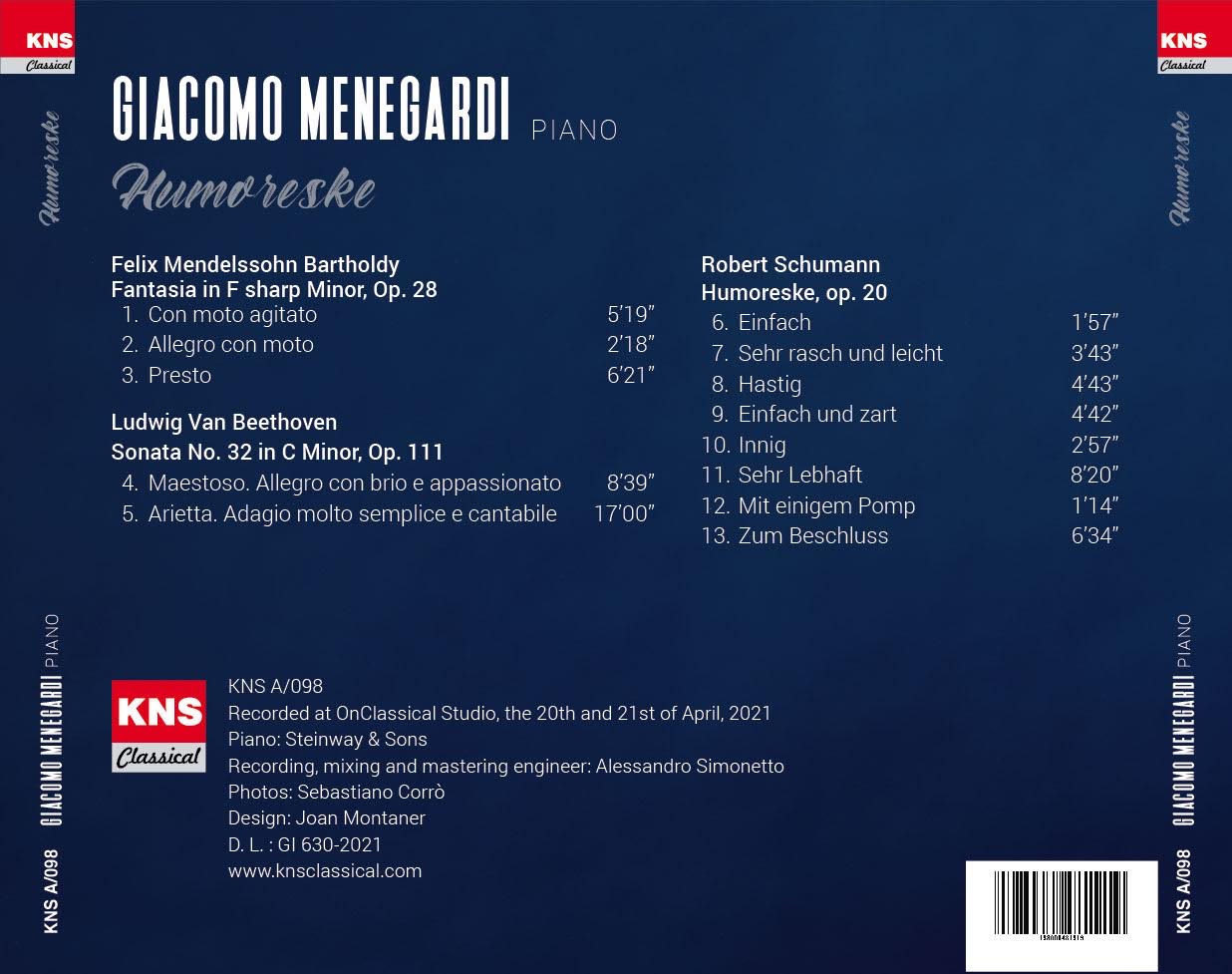
TrackList
Luca Ciammarughi, Italian Musicist
A true talent..
"..exceptionally clean. A great personality."
Jerome Rose Busoni First Prize Winner.
He is on his way..
"..to become one of Italy's finest Pianists."
