Premio Venezia
by Giacomo Menegardi September 21, 2021Musical Triumph at Venice Prize 2023: Giacomo Menegardi Claims As First Runner-up
Twenty-three-year-old Giacomo Menegardi from Belluno, who graduated with honors from the Conservatory of Castelfranco Veneto under M° Massimiliano Ferrati, won the Thirty-ninth edition of the Premio Venezia national piano competition, held these days at La Fenice Theater in Venice. In contrast, the Casella Prize, reserved for the runner-up, was awarded to 21-year-old Jacob Aumiller from Munich, who graduated with honors from the Conservatory of Trento under the guidance of M° Massimiliano Mainolfi.
These are two very different artistic personalities, testifying to the richness and educational value cultivated within Italian conservatories, as emphasized during the award ceremony by Teatro la Fenice Superintendent Fortunato Ortombina.
Solid, concentrated and always lucid, despite the final following uninterrupted days of tiring rehearsals including different repertoires, in the last round Menegardi proposed La Cathédrale engloutie from the First Book of Préludes by Claude Debussy and the Paintings from an Exhibition by Modest Mussorgsky.
What is particularly striking is the depth of perspective and the plasticity of the sound even in the most evanescent dynamics and the meticulous care in reading the text which gives depth to every detail of the writing. Everything is profoundly relived by a chameleonic musical sensitivity that is particularly at ease in the poetics of the Russian composer.
In fact, the Paintings appear to Menegardi to be a poem that encompasses life in all its nuances, from the most profane and popular to the most spiritual ones. Each painting is rendered with strength of characterization and realism, in a total symbiosis with the expressive contents and a careful valorization of the timbral intuitions inspired by the Ravelian orchestral lesson.
And Ravel himself turns out to be an author of choice for Aumiller. The incantatory aspect seems to attract this young artist who prefers half-tones and strongly underlines the obsessive trait of Ravelian composition, a challenge launched against the passage of time. If in Ondine the monk from Monaco exalts the dream and persuasiveness of song, in Le Gibet he highlights the cruelty of death with tragic vigor, while in Scarbo he explores the phantasmagorical nightmares of the night, among frightening and biting images.
Some blurriness, perhaps due to tiredness and emotion, and sometimes the difficulty in balancing the different registers of the instrument, do not compromise the personal vision of an interpreter who, although young, already has his own original aesthetic and poetic conception.
In fact, Aumiller proposes himself in this final test as a pianist-composer, an interesting idea that opens up the horizons of a competition where the performance aspect is generally rewarded above all.
His Klavierstück in E major, nourished by Schumannian and Schubertian matrices, stands out for its harmonic refinement and brilliant piano writing. We await the development of a creativity which, by frequenting the contemporary repertoire, could find new suggestions and stylistic evolutions.
He closed his performance with the fifth from the Etudes-Tableaux op. 39 by Rachmninov, rendered with pressing expressive force but not always perfect mastery of the complex and very dense piano writing.
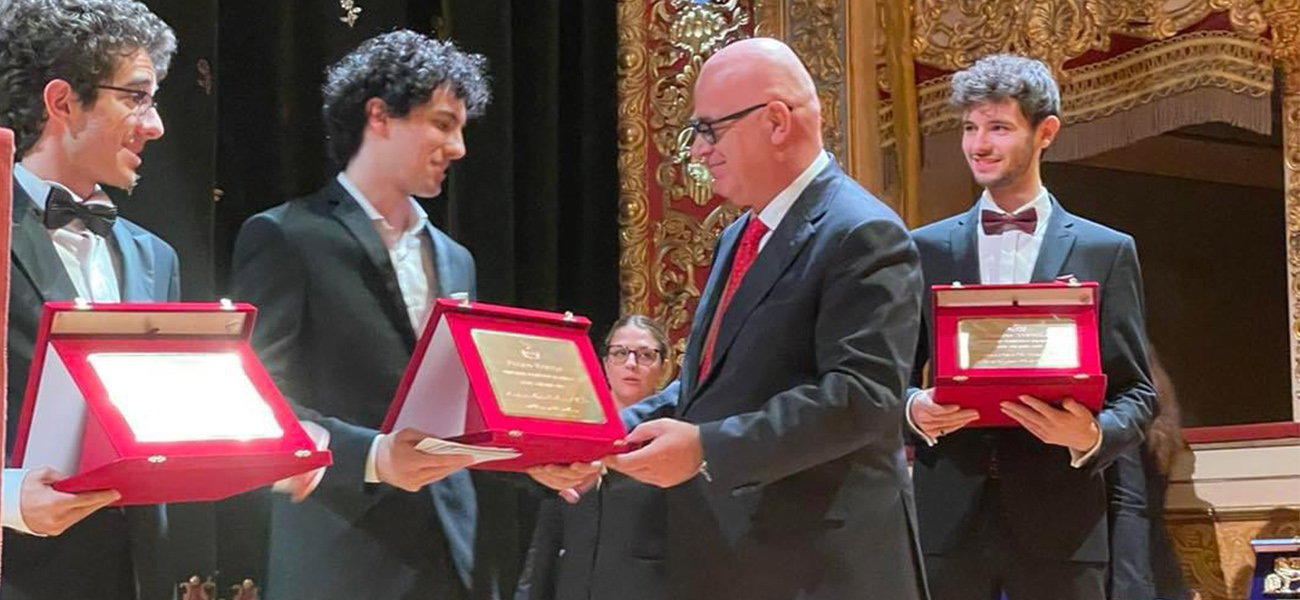
Two performers of value, therefore, joined by the other three semi-finalists, awarded with numerous scholarships during the final ceremony entrusted to the new President of the Amici della Fenice Foundation Maria Camilla Bianchini.
They are Antonio Tommaso Nastasi (“Arcangelo Corelli” Conservatory of Messina, fifth prize), Giuseppe Marco Daniele (“Stanislao Giacomoantonio” Conservatory of Cosenza, fourth prize) and Fulvio Nicolosi (“Vincenzo Bellini” Conservatory of Catania, third prize) .
The five were selected through three solo tests from around fifty competitors aged no more than 24 years old, of all nationalities, who graduated with top marks from music conservatories or recognized Italian music institutes in the 2021-2022 academic year .
An arduous job for the Technical Jury of the Award, chaired by Roberto Cominati and composed of Leonora Armellini, Roberto Calabretto, Francesco Fanna, Ana Guijarro and Paolo Pinamonti, and the Popular Jury, made up of the members of the Amici della Fenice.
The technical partner of the competition has always been Fazioli.